Inaugural FSU Autism Teaching and Learning Institute
Start Date
End Date
Location
Stone Building
1114 W Call Street, Florida State University
1114 W Call Street, Florida State University



The inaugural FSU Autism Teaching and Learning Institute is a professional development experience designed for professionals who support the instruction and development of learners with autism from early childhood through postsecondary settings. It will be held on Tuesday, July 21, from 8:30 a.m. to 4:30 p.m. in the Stone Building (1114 W Call Street, Florida State University).
The Institute is organized around evidence-based and high-leverage practices that improve academic learning, communication, social engagement, and independence.
Participants will have opportunities to:
Click here to view the full list of speakers
Strand-based sessions aligned to instructional priorities
Hands-on, practice-oriented workshops
Make and Take Studio
“Ask an Expert” roundtables for individualized support
Professional Development in PEERS® Curriculum for School-based Professionals
CEUs available for Board Certified Behavior Analysts (BCBAs), Leon County Teachers, and speech language pathologists (ASHA).
Participants must attend the sessions and complete a self-assessment to earn ASHA CEUs.

This Institute is designed for professionals who support learners with autism across educational and community settings, including:
General and special education teachers (PreK–12) across all content areas
Paraeducators
Related service providers (e.g., SLPs, OTs, behavior specialists)
Instructional coaches and school leaders
Transition specialists and postsecondary support staff
Instructional support personnel (e.g., guidance counselors, librarians)
Higher education faculty and teacher educators
Graduate students and trainees
| Time | Session |
| 8:00–8:30 | Registration & Connections over Coffee |
| 8:30–9:15 | Opening Session |
| 9:30–10:30 | Workshops Drop in: Ask a Researcher; Make & Take |
| 10:40–11:40 | Workshops Drop in: Ask a Researcher; Make & Take |
| 11:40–12:40 | Lunch |
| 12:45–1:45 | Workshops Drop in: Ask a Researcher; Make & Take |
| 1:55–2:55 | Workshops Drop in: Ask a Researcher; Make & Take |
| 3:05–4:05 | Workshops |
| 4:05–4:30 | Community Connections Reception |
id |
Workshop title & Speaker |
abstract |
objectives |
ceus available |
|---|---|---|---|---|
| A1 |
What is Autism? Zenko |
This foundational workshop introduces participants to the defining characteristics of autism and the wide range of ways autism may be expressed across individuals. Participants will explore current understandings of autism, common strengths and support needs, and factors that influence educational outcomes. Emphasis will be placed on recognizing individual differences and applying this knowledge to create responsive, supportive learning environments. |
1. Describe characteristics 2. Recognize variability 3. Identify instructional implications. |
K-12 ASHA |
| A2 |
What is Autism? (repeat) Zenko |
This foundational workshop introduces participants to the defining characteristics of autism and the wide range of ways autism may be expressed across individuals. Participants will explore current understandings of autism, common strengths and support needs, and factors that influence educational outcomes. Emphasis will be placed on recognizing individual differences and applying this knowledge to create responsive, supportive learning environments. |
1. Describe characteristics 2. Recognize variability 3. Identify instructional implications. |
K-12 ASHA |
| A3 |
Neurodiversity Perspectives Stone-McDonald |
The neurodiversity movement has transformed how educators, families, and communities think about autism and disability. This session explores neurodiversity as a framework for understanding neurological differences as natural forms of human variation rather than deficits to be fixed. Participants will examine the principles of neurodiversity, consider the implications of strengths-based approaches, and reflect on how their own beliefs and practices influence educational experiences for autistic learners. |
1. Apply a strengths-based lens 2. Describe neurodiversity principles 3. Reflect on implications |
K-12 ASHA |
| A4 |
Misinformation About Autism Fleury |
Misinformation about autism can influence educational decisions, family experiences, and service delivery in ways that negatively affect outcomes for autistic individuals. This session examines common myths, misconceptions, and unsupported claims about autism and explores why misinformation continues to spread despite advances in research. Participants will learn strategies for evaluating information sources and distinguishing evidence-based practices from unsupported approaches. |
1. Identify factors that allow misinformation to spread 2. Explain why evidence-based practices matter 3. Apply strategies to minimize the negative impact of misinformation. |
K-12 ASHA BACB- Ethics |
| A5 |
Executive Functioning Zenko |
Executive functioning skills support planning, organization, self-regulation, flexible thinking, working memory, and goal-directed behavior. Many autistic learners experience executive functioning challenges that affect academic performance, independence, and daily participation. Participants will explore the components of executive functioning and learn practical strategies to support organization, self-management, and independence across educational settings. |
1. Define executive functioning components 2. Identify executive functioning challenges in school settings 3. Apply executive functioning supports. |
K-12 ASHA |
id |
Workshop title & Speaker |
abstract |
objectives |
ceus available |
|---|---|---|---|---|
| B1 |
HLP 11: Identify and Prioritize Long- and Short-Term Goals Bowman |
Effective instruction begins with clear, meaningful goals. This session explores how educators can identify, prioritize, and align long- and short-term goals using student data, standards, and individualized learning needs. Participants will examine strategies for setting ambitious yet achievable goals that promote meaningful progress and guide instructional decision-making. |
1. Differentiate long- versus short-term goals. 2. Prioritize goals using data 3. Align goals with standards and IEPs. |
K-12 ASHA |
| B2 |
HLP 12: Systematically Design Instruction Jimenez (Access Points focus) |
Designing effective instruction requires intentional planning and alignment. Participants will learn how to use backward design principles to connect learning outcomes, assessment, and instructional activities. This session emphasizes instructional coherence and provides practical tools for developing lessons that support meaningful engagement and achievement for diverse learners. |
1. Apply backward design 2. Align tasks to outcomes 3. Evaluate instructional coherence. |
K-12 ASHA |
| B3 |
HLP 13: Adapt Curriculum Tasks & Materials Mims (Access Points focus) |
Students learn best when curriculum materials are accessible and appropriately challenging. This workshop focuses on adapting curriculum tasks and instructional materials for students with autism who are on access points to increase participation and learning while preserving high expectations. Participants will explore strategies for reducing unnecessary barriers and creating meaningful access to grade-level content. |
1. Modify tasks to reduce extraneous load 2. Adapt materials to learner needs 3. Evaluate impact on access. |
K-12 ASHA |
| B4 |
HLP 15: Provide Scaffolded Supports Root |
Scaffolds help learners successfully access new skills and content while building independence over time. Participants will examine different types of instructional scaffolds, learn how to match supports to student needs, and develop plans for systematically fading supports as learners gain competence and confidence. |
1. Identify scaffold types 2. Match scaffolds to needs 3. Plan for fading supports. |
K-12 ASHA BACB- Learning |
id |
Workshop title & Speaker |
abstract |
objectives |
ceus available |
|---|---|---|---|---|
| C1 |
HLP 20: Intensive Intervention Mims (Access Points focus) |
Some learners require instruction that is more individualized, systematic, and intensive. This session focuses on identifying when intensification is needed, designing individualized intervention plans, and using ongoing progress monitoring to evaluate effectiveness. Participants will learn practical approaches for intensifying instruction while maintaining meaningful participation in educational environments. |
1. Identify need for intensification 2. Design individualized interventions 3. Monitor response to intervention. |
K-12 ASHA |
| C2 |
HLP 16: Explicit Instruction Cox (Secondary focus) |
Explicit instruction is one of the most effective instructional approaches for improving academic outcomes. This session focuses on applying explicit instruction principles in secondary settings, including clear modeling, guided practice, feedback, and systematic skill development. Participants will learn strategies that support both academic achievement and independence. |
1. Use explicit instruction components 2. Sequence instruction clearly 3. Use modeling and guided practice. |
K-12 ASHA |
| C3 |
HLP 16: Explicit Instruction Thompson (Elementary focus) |
This workshop introduces evidence-based components of explicit instruction for elementary learners. Participants will explore strategies for delivering clear, systematic instruction that promotes engagement, understanding, and skill acquisition. Practical examples and implementation tools will be shared throughout the session. |
1. Use explicit instruction components 2. Sequence instruction clearly 3. Use modeling and guided practice. |
K-12 ASHA BACB- Learning |
| C4 |
HLP 14: Cognitive & Metacognitive Strategies Cox |
Successful learners use strategies to plan, monitor, and evaluate their own learning. Participants will explore cognitive and metacognitive instructional approaches that help students develop self-awareness, self-monitoring, and strategic problem-solving skills. Examples will be drawn from a variety of academic content areas. |
1. Model strategies 2. Teach self-monitoring 3. Embed strategies across content. |
K-12 ASHA |
| C5 |
HLP 21: Maintenance & Generalization Denning |
Learning is only meaningful when skills are maintained and used across settings, people, and activities. This workshop focuses on planning for maintenance and generalization from the beginning of instruction. Participants will explore practical strategies for promoting durable learning and transfer of skills beyond instructional contexts. |
1. Plan for maintenance 2. Design instruction to promote generalization 3. Use varied practice strategies. |
K-12 ASHA |
id |
Workshop title & Speaker |
abstract |
objectives |
ceus available |
|---|---|---|---|---|
| D2 |
HLP 11: Positive Behavior Supports Fleury |
Positive behavior supports create environments that promote engagement, learning, and belonging. Participants will learn how to design proactive supports, address challenging behavior through prevention-focused approaches, and use data to evaluate outcomes. The session emphasizes practical classroom applications that support student success. |
1. Apply proactive strategies 2. Design function-based supports 3. Monitor behavior outcomes. |
K-12 ASHA BACB- Learning |
| D3 |
HLP 4: Use Multiple Sources of Information Romig |
Effective educational decisions require multiple forms of evidence. This workshop examines how educators can combine formal and informal data sources to better understand student needs, identify meaningful patterns, and guide instructional planning. Participants will explore practical approaches to data-informed decision making. |
1. Use formal and informal data 2. Identify patterns 3. Inform instruction with data. |
K-12 ASHA |
| D4 |
HLP 18: Active Engagement Thompson (Elementary focus) |
Engagement is a critical predictor of learning. This session focuses on strategies for increasing active participation among elementary learners through opportunities to respond, meaningful interaction, and developmentally appropriate instructional practices. Participants will learn methods for monitoring and improving student engagement. |
1. Increase opportunities to respond 2. Use developmentally appropriate strategies 3. Monitor engagement. |
K-12 ASHA BACB- Learning |
| D5 |
HLP 18: Active Engagement Romig (Secondary focus) |
Secondary learners benefit from instruction that promotes active participation, autonomy, and relevance. Participants will explore strategies for increasing engagement through choice, meaningful interaction, and responsive instructional design. Practical examples will emphasize implementation in middle and high school settings. |
1. Design meaningful opportunities to respond 2. Incorporate choice 3. Sustain engagement over time. |
K-12 ASHA |
id |
Workshop title & Speaker |
abstract |
objectives |
ceus available |
|---|---|---|---|---|
| E2 |
HLP 19: Assistive & Instructional Technologies Shurr |
Technology can increase access, participation, communication, and independence for learners with diverse needs. This workshop examines how to identify appropriate technologies, match tools to student needs, and evaluate their effectiveness. Participants will explore practical examples and implementation considerations across educational settings. |
1. Identify appropriate technologies 2. Match tools to needs 3. Evaluate impact. |
K-12 ASHA |
| E3 |
HLP 17: Flexible Grouping McConomy |
Flexible grouping allows educators to respond to diverse learning needs while promoting meaningful peer interactions. Participants will learn strategies for organizing and adjusting groups based on instructional goals, student strengths, and ongoing assessment data. Practical examples will highlight inclusive and collaborative learning opportunities. |
1. Group strategically 2. Facilitate peer interaction 3. Adjust groups using data. |
K-12 ASHA |
| E4 |
HLP 7: Learning Environment McConomy (Secondary focus) |
Learning environments influence student behavior, engagement, and independence. This session focuses on creating secondary classrooms that promote self-management, predictability, and successful transitions. Participants will explore strategies for establishing structures that support both academic and behavioral success. |
1. Promote self-management 2. Maintain consistent expectations 3. Support transitions. |
K-12 ASHA BACB- Learning |
| E5 |
HLP 7: Learning Environment Thompson (Elementary focus) |
Learning environments play a critical role in supporting engagement and development. Participants will explore strategies for establishing routines, organizing physical spaces, and fostering positive classroom climates in elementary settings that support participation and learning for all students. |
1. Establish routines 2. Organize space 3. Promote positive climate |
K-12 ASHA BACB- Learning |
id |
Workshop title & Speaker |
abstract |
objectives |
ceus available |
|---|---|---|---|---|
| F2 |
ACT FASTT Toolkit LaPoint (Post-Secondary focus) |
The ACT FASTT Toolkit provides practical resources for supporting transition planning and implementation. Participants will explore toolkit components, examine strategies for integrating resources into practice, and identify opportunities to strengthen transition-focused instruction and planning. |
1. Identify toolkit features 2. Apply strategies to instruction 3. Support implementation |
K-12 ASHA |
| F3 |
HLP 14: Independence Gilley (Secondary focus) |
Independence is a critical predictor of long-term quality of life and postschool outcomes. This workshop focuses on embedding self-determination and independence-building opportunities throughout instruction. Participants will learn strategies for supporting decision-making, problem-solving, self-advocacy, and authentic participation. |
1. Embed self-determination instruction 2. Facilitate decision-making and problem-solving 3. Design authentic learning experiences |
K-12 ASHA |
| F4 |
Peer Supports Gilley (Secondary focus) |
Peer-mediated approaches can strengthen inclusion, engagement, relationships, and learning. Participants will explore strategies for designing peer support programs, training peer partners, and using data to evaluate implementation and outcomes. Practical examples will highlight applications across academic and social contexts. |
1. Incorporate peer-mediated instructional strategies 2. Train and support peer mentors 3. Analyze and strengthen peer programs. 4. Use data to improve implementation. |
K-12 ASHA |
| F5 |
Postsecondary Accommodations LaPoint (Post-Secondary focus) |
Preparing students for postsecondary success requires intentional planning and self-advocacy development. This session examines common postsecondary accommodations, legal considerations, and strategies for supporting students as they transition to higher education, employment, and community settings. |
1. Evaluate accommodation effectiveness 2. Align accommodations with student needs 3. Promote self-advocacy |
K-12 ASHA |
id |
Workshop title & Speaker |
abstract |
objectives |
ceus available |
|---|---|---|---|---|
| G1 |
HLP 3: Family Collaboration Stansberry Brusnahan (Secondary focus) |
Strong partnerships with families improve educational outcomes and transition success. This session focuses on communication strategies, collaborative decision-making, and approaches for building authentic partnerships with families of secondary students. |
1. Build communication. 2. Engage families in decisions. 3. Connect families to resources. |
K-12 ASHA |
| G2 |
HLP 1: Co-Teaching Bowman |
Effective co-teaching requires shared responsibility, communication, and instructional planning. Participants will examine common co-teaching models, discuss strategies for collaborative planning, and identify approaches for maximizing the strengths of both educators in inclusive settings. |
1. Identify co-teaching models 2. Plan collaboratively 3. Evaluate effectiveness |
K-12 ASHA |
| G3 |
HLP 1: SLP Collaboration Williams |
Collaboration between educators and speech-language pathologists is essential for supporting communication and learning. This session explores strategies for aligning goals, coordinating services, and sharing data to improve student outcomes. |
1. Align goals 2. Coordinate services 3. Share data. |
K-12 ASHA |
| G4 |
HLP 1: Paraeducators Stansberry Brusnahan |
Paraeducators play an important role in supporting student learning and participation. Participants will examine effective paraeducator roles and responsibilities, strategies for communication and feedback, and approaches for promoting student independence while maintaining high-quality supports. |
1. Define roles 2. Provide feedback 3. Promote independence |
K-12 ASHA |
| G5 |
HLP 3: Family Collaboration Stone-McDonald (Elementary focus) |
Family-school partnerships established during the elementary years can have lasting impacts on student outcomes. Participants will explore strategies for building trust, fostering communication, engaging families in decision-making, and connecting families with resources that support learning and participation. |
1. Build communication 2. Engage families in decisions 3. Connect families to resources |
K-12 ASHA |
id |
Workshop title & Speaker |
abstract |
objectives |
ceus available |
|---|---|---|---|---|
| H |
PEERS for School Based Professionals Howorth |
PEERS® is an evidence-based social skills intervention designed to improve social competence and relationship development for adolescents and young adults. This workshop introduces participants to the core methodology of the PEERS program, including strategies for teaching social skills, coaching learners in authentic contexts, and monitoring progress over time. Participants will gain practical tools that can be applied within school settings to support meaningful social engagement and peer relationships. |
1. Implement Core Methodology 2. Coach Essential Social Skills 3. Manage and Track Progress |
K-12 ASHA BACB-Learning |
Registration
Do I need to register in advance?
Yes, registration is required to attend.
What if I can no longer attend?
We understand that plans change! Please let us know as soon as possible by completing our cancellation form.
How will I receive proof of attendance?
If you need CEUs or a certificate of attendance, be sure to sign in at each session you attend following instructions provided by presenters.
We will verify attendance after the Institute and send your documentation to the email address you used to register within 30 days.
Sessions
Do I need to register for specific workshops?
Unless you are completing the PEERS training, there is no need to sign up for individual workshops or drop-in sessions in advance. Simply attend the sessions that interest you and take advantage of the opportunities to learn, connect, and share ideas throughout the day.
Will presentation slides or handouts be available?
Many presenters will share digital resources. Participants will also receive “Big Idea” guided notes developed by institute organizers to support learning and note-taking.
I’m new to autism. Which workshops should I attend?
We welcome participants with a wide range of experience. The schedule includes introductory sessions as well as more specialized topics.
Each workshop includes a description and learning objectives. Choose sessions based on your professional role, current interests, or areas where you’d like practical strategies.
Can I ask presenters questions outside of their sessions?
Yes. Presenters will participate in the Ask-a-Researcher room during the day, providing opportunities for one-on-one conversations, consultation, and discussion.
Logistics
When should I arrive?
Registration opens at 8:00 am. The opening session begins at 8:30 am in the College of Medicine auditorium.
Can I attend only part of the day?
Yes, although we encourage participants to attend the full institute to take advantage of all workshops and networking opportunities.
Where should I park?
Complementary parking for registered attendees is available on Level 2 of Spirit Way Garage, located at 1122 Spirit Way, Tallahassee, FL 32304
We ask that FSU employees use the faculty and staff parking lots adjacent to Stone building or King Life Science Building.
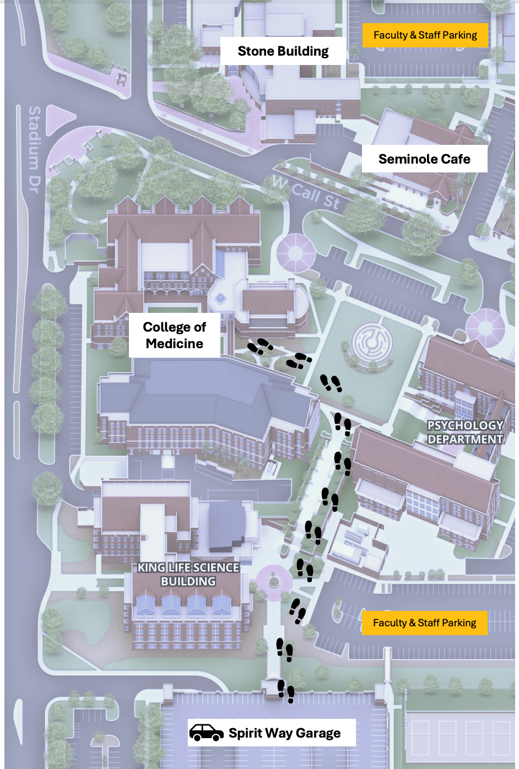
How do I get to registration in the College of Medicine from Spirit Way garage?
The map below shows the path to walk from Spirit Way Garage to the College of Medicine Auditorium where registration, refreshments, and the opening session are located.
The address for the College of Medicine is 1115 W. Call Street, Tallahassee, FL 32304
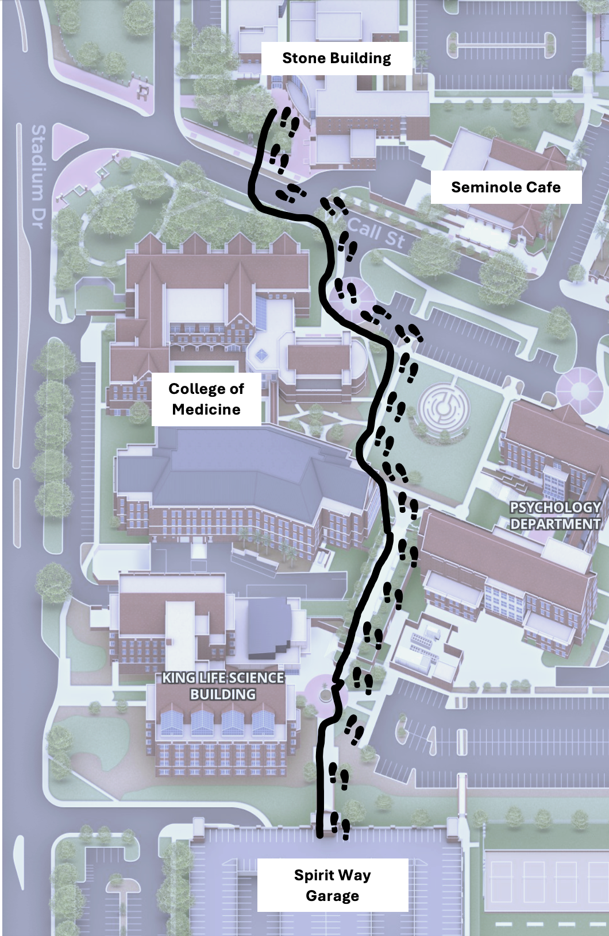
How do I get to the workshops in Stone Building from Spirit Way garage?
The map below shows the path to walk from Spirit Way Garage to Stone Building where the workshops will be held.
The address for Stone Building is 1114 W Call Street, Tallahassee, FL 32304
What should I wear?
Casual professional attire is appropriate. Meeting rooms can be cool, so we recommend bringing a light sweater or jacket.
What should I bring?
A laptop or tablet is recommended but not required. You may also wish to bring a reusable water bottle.
Will meals be provided?
Yes. Morning coffee, tea, and pastries, lunch, and an afternoon networking reception with desserts and beverages are included with registration.
Registered attendees will eat lunch at Seminole Cafe (located next to Stone building), which provides vegan, vegetarian, and gluten-free options. There is also a “Stress-Less zone” that offers pre-packaged food items that limit or avoid peanuts, tree nuts, and/or gluten. This is open to all, but be advised there is a risk of cross-contact.
We strive to host accessible events that enable all individuals to engage fully. For inquiries about accessibility, please contact Dr. Jenny Root at jrroot@fsu.edu.
