From FSU to the Future of Sport Psychology
Sport psychology pioneer and FSU alumna Jean Williams establishes an endowment to support future generations of sport psychology students at Anne’s College.
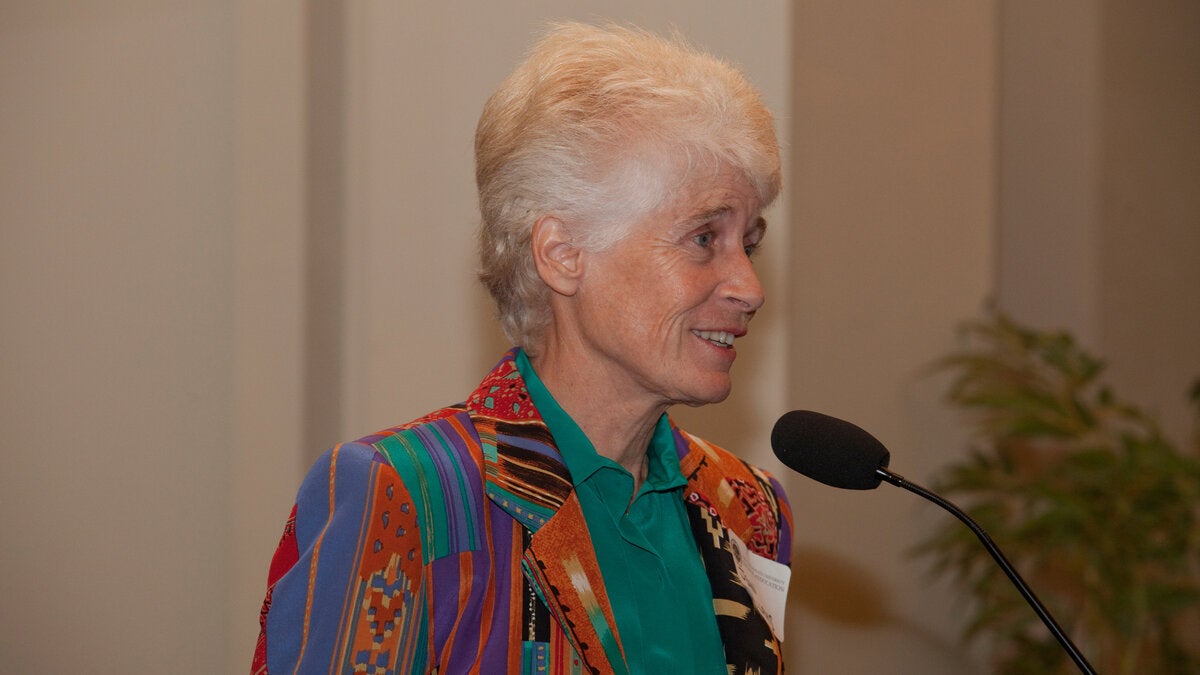


Sport psychology pioneer and FSU alumna Jean Williams establishes an endowment to support future generations of sport psychology students at Anne’s College.
When Jean Williams began coaching fencing at San Jose State University, she recognized something that the physical education field had yet to fully explain: the mental component of the sport and the mind’s powerful influence on athletic performance.
“After four or five years of coaching, I realized how critical the mental game was,” she said. “At that time, the field of sport psychology was so much in its infancy. We didn’t have research or a database to understand mentally what influenced performance, let alone the techniques that could be used to help train people.”
Williams would go on to become a pioneer in sport psychology, helping establish professional standards and connecting scientific research with practical application. She traces her professional success back to her graduate studies at FSU and Anne’s College.
“Florida State was regarded as one of the three best universities for early sport psychology alongside the University of Illinois and Penn State,” Jean said.
The university’s strong reputation and the opportunity to study under Robert Singer, a leading scholar in sport psychology and motor learning, drew Williams to Tallahassee. As an Iowa native, she also admits the Florida climate was a selling point.
“I didn’t want to go back to the cold,” she joked. “And it turned out to be just an absolutely outstanding decision for me.”
Williams earned her Ph.D. in movement science at FSU in 1975. The program, a precursor to many kinesiology-related programs at Anne’s College, focused on sport psychology, motor learning, exercise physiology and biomechanics. Its emphasis on research set it apart from many graduate programs of the time, Williams says.
“I started out in what was the beginning years of sport psychology in the mid-70s. It was especially rare to have a program with as much emphasis on research as we did at Florida State,” she said. “When I look back on my career, I really credit my success, my education philosophy, and my approach to working with students to my time at Florida State.”
Now, Williams is giving back to the program that helped shape her career through the Jean M. Williams Endowment for Sport Psychology, the first sport psychology endowment created by an alumna to support excellence and continued growth in the field at FSU.
As sport psychology developed into an established professional field, FSU graduates helped advance research, establish standards, and prepare future generations of practitioners. Williams carried that foundation into a career devoted to strengthening both the science and practice of the field.
“Florida State recognized early the need for both research and applied practice,” she said. “To start to train people and promote the applied aspect, you need that body of research.”
Early in the profession, Williams recalled, standards were still taking shape. “All someone had to do at the time was print a business card, put ‘sport psychologist’ on it, and off they went,” she said.
In the mid-1980s, Williams and John Silva, a professor at the University of North Carolina, advocated for the establishment of the Association for Applied Sport Psychology (AASP) to strengthen research, professional training and certification. Williams later became the organization’s eighth president and its first female president. She is now an AASP fellow and consultant, and she is a fellow of the National Academy of Kinesiology.
She spent the entirety of her professional career at the University of Arizona. Despite serving as the sole sport psychology faculty member for much of her early career, she helped develop one of the country’s largest graduate programs in the discipline.
Her academic career spanned the Department of Exercise and Sport Science and the Department of Psychology at Arizona, where her research helped expand the field’s evidence base, including work on stress, coping, health psychology and the relationship between stress and athletic injury. The area of research for which she’s most known grew from a master’s student’s question about whether stress contributed to an injury he had experienced while serving in the military.
“I’m inquisitive. If I see a question and we don’t have an answer to it, that drives me to find out how we can get answers.”
Williams encouraged students to follow their own questions, even when they fell outside her areas of expertise.
“Whatever research question my students had, even if it was something I didn’t cover in my coursework or in my research, I let them pursue that,” she said. “I saw it as my responsibility to get caught up on that literature so I could advise them.”
Her work includes nine books, more than 100 research publications and numerous book chapters. She is also the author and editor of Applied Sport Psychology: Personal Growth to Peak Performance, an influential textbook in the field. In 2012, Anne’s College recognized her contributions with a Distinguished Alumni Award.
With all she’s accomplished, Williams considers mentoring students among the most rewarding aspects of her career.
“I love my research. I love my service. But I loved teaching, too, and seeing the excitement of my students as they became more and more interested in sport psych, and as their commitment to it grew,” she said.
That passion for education and advancing the field continues through her endowment at Anne’s College.
The fund will provide flexible support for FSU’s sport psychology program and its students, advancing scholarship, research and educational opportunities. Williams hopes it will help future students gain the kind of foundation she found at FSU.
“Many of the graduate students at Florida State have gone on to be leaders in terms of advancing the profession, conducting research, and training new pipelines of students.”
For Williams, the gift is a way to recognize what FSU gave her and help the program continue to shape the field.
“I wanted a way to acknowledge that and pay it forward, and help FSU continue to have one of the best programs in the country,” she said.
Throughout her career, Williams championed the relationship between scientific research and practical application. She maintained the same curiosity and commitment to discovery that first drew her to FSU and the field of sport psychology.
Her advice to the next generation of sport psychology students at Anne’s College reflects the passion that has guided her career.
“Despite many 60- or 70-hour work weeks, I can honestly say I’ve never worked a day in my life,” she said. “Have a passion for your job; have a passion for your field. Hopefully that’s in sport psychology, but if you’ve lost your passion for what you’re doing, move on to something where you can reignite that.”